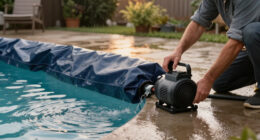
Choosing the right sewage pump basin kit for temporary setups involves balancing capacity, durability, and ease of installation. For quick-deploy solutions, I’ve identified top picks that excel in different scenarios. Acquaer’s 1/2 HP Submersible Sewage Pump stands out for its impressive 6000 GPH flow rate, making it ideal for large-scale drainage. Meanwhile, WASSERMANN’s 1/2 HP Submersible Pump offers straightforward installation with reliable solids handling. The VEXOR Sewage Pump System makes a compact, budget-friendly choice for outdoor water collection. Each choice involves tradeoffs, whether in flow capacity, size, or suitability for specific environments, so understanding your setup’s demands is key.

Get pool and patio gear delivered free — and shop member deals
- Fast, free delivery on millions of items
- Access to Prime Big Deal Days deals on October 6–7
- Prime Video, Amazon Music and more included
Complete the kit


Key Takeaways
- High flow rates up to 6400 GPH are best for large-scale drainage but often come with increased size and power needs.
- Durability and corrosion resistance, especially with cast iron construction, are critical for long-term temporary setups exposed to moisture and debris.
- Automatic float switches simplify operation in temporary installations, but proper handling and positioning are essential for optimal performance.
- Larger pumps typically require more space and power, making compact options more suitable for limited areas.
- Choosing a pump designed for outdoor or indoor use depends heavily on environmental conditions and potential freezing risks.


| sewage pump basin kit for temporary setup | Maximum Lifting Height | Voltage | Horsepower | Flow Rate |
|---|---|---|---|---|
| Acquaer 1/2 HP Submersible Sew | 27 feet | 115 volts | 0.5 hp | — |
| 1/2 HP Sewage Pump 6020 GPH Ca | 28 feet | 115 volts | 0.5 hp | 100.33 gpm |
| VEVOR Sewage Pump System | 23 feet | 120 Volt | — | 4800 GPH |
| 3/4 HP Submersible Sewage Pump | 29 feet | 120 volts | 0.75 hp | 107 gpm |
| WASSERMANN 1/2 HP Submersible | 23 feet | 115 volts | 0.5 hp | 5300 GPH |
More Details on Our Top Picks
Acquaer 1/2 HP Submersible Sewage Pump 6000 GPH Auto Vertical Float Switch
This model excels in large-scale temporary setups thanks to its impressive 6000 GPH flow rate and robust cast iron build. The high-efficiency oil-filled motor delivers reliable performance, and the vertical float switch makes it easy to automate operation. Compared with similar options, its high capacity makes it suitable for demanding scenarios, but it requires full submersion and proper protection from freezing temperatures, which could complicate outdoor winter use.
Pros:- High-capacity pumping up to 6000 GPH
- Durable cast iron construction
- Automatic and manual operation with float switch
Cons:- Not suitable for septic tanks
- Requires full submersion and protection from freezing
Best for: Large drainage tasks, construction sites, or emergency water removal where high flow capacity is essential.
Not ideal for: Septic tank applications or environments prone to freezing without additional insulation.
- Power Source:AC
- Maximum Lifting Height:27 feet
- Voltage:115 volts
- Horsepower:0.5 hp
- Material Type:Cast Iron
- Discharge Port:2 inches NPT
Our verdict“This pump is perfect for large, temporary drainage needs where capacity and durability are priorities.”
1/2 HP Sewage Pump 6020 GPH Cast Iron Effluent Pump with Float Switch
Compared to the Acquaer model, this pump offers a slightly higher maximum lifting height of 28 feet and a 6020 GPH flow rate, making it well-suited for basement drainage and effluent ponds. Its cast iron body and waterproof features provide resilience in outdoor or damp environments. The built-in thermal overload protector enhances safety, but handling the power cord carefully is essential to avoid damage. Its size is manageable for most temporary setups, but it’s not designed for freezing conditions without additional insulation.
Pros:- High flow rate of 6020 GPH
- Corrosion-resistant cast iron
- Automatic float switch with thermal protection
Cons:- Requires careful handling to prevent damage
- May need a debris filter for large solids
Best for: Basement drainage, effluent ponds, or outdoor outdoor sewage collection where automatic operation is needed.
Not ideal for: Heavy debris environments unless a filter is added or for freezing conditions without proper precautions.
- Flow Rate:100.33 gpm
- Maximum Lifting Height:28 feet
- Voltage:115 volts
- Horsepower:0.5 hp
- Material:Cast Iron
- Discharge Size:2″ NPT
- Warranty:2 years
Our verdict“A reliable choice for automatic sewage and effluent management in moderate outdoor or basement settings.”
VEVOR Sewage Pump System, 1/2 HP, 4800 GPH, Cast Iron, 120V, Automatic On/Off with Float Switch, 2″ Discharge
Compared with larger, high-capacity pumps, the VEVOR system offers a compact and affordable solution for outdoor water collection or seepage. Its 4800 GPH flow rate is sufficient for smaller temporary projects, and the cast iron construction ensures durability. The automatic on/off feature simplifies operation, but its outdoor-specific design means it isn’t ideal for indoor or heavily debris-laden environments. Its smaller size makes it easier to install in tight spaces, though it may require a larger footprint for larger tasks.
Pros:- Compact size and easier installation
- Automatic operation with float switch
- Durable cast iron construction
Cons:- Limited to outdoor use
- Lower flow rate compared to larger pumps
Best for: Outdoor water or seepage collection where space is limited and moderate flow is sufficient.
Not ideal for: Large-scale sewage or basement drainage requiring higher flow rates or indoor use.
- Flow Rate:4800 GPH
- Maximum Lifting Height:23 feet
- Voltage:120 Volt
- Discharge Size:2 inches
- Material:Cast Iron
Our verdict“A space-saving, outdoor-appropriate pump ideal for light to moderate temporary water removal tasks.”
3/4 HP Submersible Sewage Pump 6400 GPH Cast Iron Effluent Pump
Compared to the 1/2 HP options, this 3/4 HP pump provides a higher flow rate of 6400 GPH and a maximum head of 29 feet, making it suitable for more demanding basement drainage or sewage applications. Its cast iron shell and vortex impeller design ensure durability and clog resistance. The inclusion of both automatic and manual controls offers flexible operation, but this model’s size and weight mean it’s less suitable for tight spaces or portability. It also requires careful handling to prevent freezing if used outdoors in low temperatures.
Pros:- High flow rate of 6400 GPH
- Robust cast iron construction
- Automatic and manual control options
Cons:- Heavier and larger than smaller models
- Needs careful handling to prevent freezing
Best for: Heavy-duty drainage or sewage management in basements or larger temporary outdoor sites.
Not ideal for: Small or indoor projects where a more compact or lower-power pump suffices.
- Flow Rate:107 gpm
- Maximum Lifting Height:29 feet
- Voltage:120 volts
- Horsepower:0.75 hp
- Material:Cast Iron
- Discharge Size:2″ NPT
- Warranty:2 years
Our verdict“Ideal for demanding drainage tasks where higher flow and head are necessary, with a focus on durability.”
WASSERMANN 1/2 HP Submersible Sewage Pump with Auto Float Switch, 115V, 5300 GPH, Cast Iron, 2″ NPT Discharge, 10 FT Cable
In comparison to larger pumps, the WASSERMANN model offers a reliable balance of flow rate at 5300 GPH and ease of installation for below-grade or basement drainage. Its cast iron body and vortex impeller enable passing of 2-inch solids, reducing clog risks. The 10-foot cable limits placement flexibility somewhat, but for typical temporary basement applications, this model provides a straightforward, durable solution. It’s less suited for outdoor or freezing environments without additional precautions.
Pros:- High flow rate for basement drainage
- Cast iron, clog-resistant vortex impeller
- Automatic float switch for convenience
Cons:- Heavy weight complicates handling
- Limited cable length for some setups
Best for: Basement or flood-prone area drainage where ease of install and clog resistance are priorities.
Not ideal for: Outdoor or extremely large-scale sewage projects requiring higher flow or longer cable runs.
- Flow Rate:5300 GPH
- Maximum Lifting Height:23 feet
- Voltage:115 volts
- Horsepower:0.5 hp
- Material:Cast Iron
- Discharge Size:2″ NPT
- Cable Length:10 ft
Our verdict“A practical, durable choice for basement flood prevention and drainage needs with straightforward installation.”

How We Picked
My selection process involved evaluating each pump’s capacity, durability, ease of installation, and suitability for temporary setups. I prioritized pumps with high flow rates to handle large volumes efficiently, especially important in construction or emergency scenarios. Cast iron construction was favored for its durability against corrosion and physical impacts. Automatic float switches were a key feature for ease of use, reducing manual intervention. I also considered size and power requirements to ensure options fit various temporary site conditions. Lastly, I balanced performance with cost-effectiveness, ensuring each pick offers value for different types of temporary sewage management.
Factors to Consider When Choosing Sewage Pump Basin Kit For Temporary Setups
When selecting a sewage pump basin kit for temporary setups, key factors include flow capacity, durability, ease of installation, and environmental compatibility. The right pump depends on whether the setup is indoor or outdoor, the expected volume of water or sewage, and whether automatic operation is needed. Considering these aspects ensures your temporary solution remains reliable, efficient, and safe for the duration of your project.
Flow Rate & Capacity
For most temporary setups, a pump with at least 4800 GPH (gallons per hour) is advisable to handle moderate to large volumes efficiently. Larger flow rates are preferable in construction or emergency scenarios, but they often require more space and power. Smaller pumps around 4800 GPH are well-suited for outdoor seepage or basement drainage where space is limited.
Material & Durability
Cast iron remains the standard for temporary sewage pumps because of its resistance to corrosion and physical impacts. Pumps with cast iron construction tend to last longer in outdoor environments and handle debris better, though they are heavier. For indoor or protected environments, lighter materials may suffice but could compromise longevity.
Automation & Ease of Use
Automatic float switches simplify operation, especially in temporary setups where manual control may be inconvenient. Ensure the float switch is appropriately positioned to avoid false triggers, and consider models with thermal overload protection for safety. Manual override options are also beneficial for precise control when needed.
Size & Power Requirements
Size and power are critical for fitting the pump into your setup. Compact models are easier to install in tight spaces but may have lower flow capacities. Ensure your power supply matches the pump’s voltage requirements—most operate at 115V, but some larger models may need higher voltages. Handling and transport considerations also matter for temporary setups.
Frequently Asked Questions
Can I use these pumps for outdoor sewage applications?
Most of these pumps are suitable for outdoor use, especially those with cast iron construction and waterproof features. However, you should check whether they can withstand freezing temperatures or require insulation or protection from the elements. Pumps like the Acquaer and VEVOR are designed for outdoor water collection, but freezing conditions may necessitate additional safeguards.
What flow rate should I look for in a temporary sewage setup?
For moderate to large-scale temporary setups, a flow rate of at least 4800 GPH is recommended. This ensures efficient removal of water or sewage without overloading the system. Larger flows, such as 6400 GPH, are better for demanding applications like basement sewage or construction dewatering, but they come with increased size and power requirements.
How important is automatic operation in these pumps?
Automatic float switches greatly enhance ease of use, especially in unattended or hard-to-reach locations. They allow the pump to turn on and off based on water levels, reducing the need for manual intervention. For temporary setups where quick deployment and safety are priorities, automatic operation is highly beneficial, though it requires proper installation and positioning of the float switch.
Are these pumps suitable for handling solids or debris?
Yes, most of these pumps feature vortex impellers designed to pass 2-inch solids, reducing clogging risks. For environments with larger debris, consider adding filters or screens to prevent damage. Proper handling and regular maintenance also help keep the pumps functioning effectively in debris-laden conditions.
What are the main differences between 1/2 HP and 3/4 HP pumps?
Higher horsepower pumps, like the 3/4 HP model, typically offer increased flow rates and greater head heights, making them suitable for larger or more demanding tasks. However, they are often larger, heavier, and may require more power and space. For smaller or indoor setups, 1/2 HP pumps generally suffice and are easier to handle and install.
Conclusion
For large-scale or high-capacity temporary sewage setups, the Acquaer 1/2 HP Submersible Sewage Pump offers unmatched flow and durability, making it ideal for construction sites or emergency dewatering. The 1/2 HP Sewage Pump by WASSERMANN is a reliable choice for basement drainage where automatic operation is needed. If outdoor or seepage applications are the focus, the VEVOR Pump System provides a compact, cost-effective solution. For demanding basement or sewage management, the 3/4 HP Submersible Pump delivers extra power, though at the expense of size and weight. Understanding your specific site conditions and needs will guide you to the best fit among these options.
Halloween Picks
halloween
As an affiliate, we earn on qualifying purchases.