To prevent blackouts during your event, first list all devices, lights, and appliances you’ll use and check their wattage ratings. Sum these wattages and add a safety margin of 10-25% for unexpected surges, especially for motors and compressors with high startup wattage. Choose a generator that exceeds this total to handle peak loads comfortably and avoid overloads. If you’re unsure about exact calculations, there’s more to contemplate for a reliable setup that keeps everything running smoothly.
Key Takeaways
- List all event equipment and appliances, then sum their wattage ratings to determine total load.
- Include starting wattage for motors and compressors by multiplying running wattage by 2-3 times.
- Add a safety margin of 10-25% to the total wattage to account for unforeseen power spikes.
- Select a generator with capacity exceeding the adjusted load, including future expansion needs.
- Consider peak load variations during the event to ensure the generator can handle fluctuating power demands.
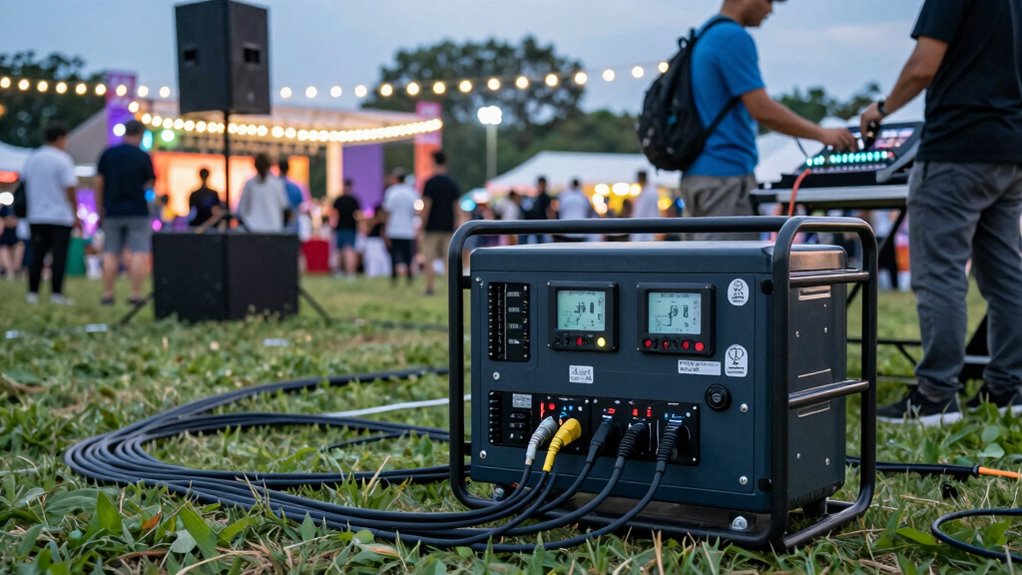
Planning an event requires guaranteeing you have enough power to run all your equipment smoothly, and choosing the right generator size is vital for that. Your first step is to accurately assess your power demand, which involves calculating the total wattage of all devices, lights, and appliances you’ll need during the event. This process is essential because underestimating your power demand can lead to insufficient energy, risking equipment failure or unexpected blackouts. Conversely, overestimating can result in purchasing a generator that’s larger and more expensive than necessary. To strike the right balance, it’s wise to include a safety margin—an extra 10-25% beyond your calculated load—to accommodate any unforeseen power spikes or additional equipment that might be added later.
Understanding your power demand begins with listing every piece of equipment you plan to use. Check each device’s wattage rating, often found on labels or in user manuals. If only amperage ratings are available, multiply the amperage by the voltage (typically 120V or 240V) to find the wattage. Add up all these figures to determine your total power requirement. Remember, some equipment, especially motors and compressors, draw more power at startup than during normal operation. To account for this, include a starting wattage factor—usually 2-3 times the running wattage—to guarantee your generator can handle initial surges without tripping or underperforming.
List all equipment wattages, including starting wattage for motors and compressors, to accurately gauge your power needs.
When choosing your generator, aim for one that can comfortably handle your calculated load plus the safety margin. This buffer helps prevent overloads and ensures consistent performance. It’s also wise to consider future expansion—perhaps you’ll add more lighting or equipment—so selecting a slightly larger generator now can save you trouble later. Keep in mind that running a generator at or near its maximum capacity reduces its lifespan and efficiency, so always opt for a size that provides some breathing room.
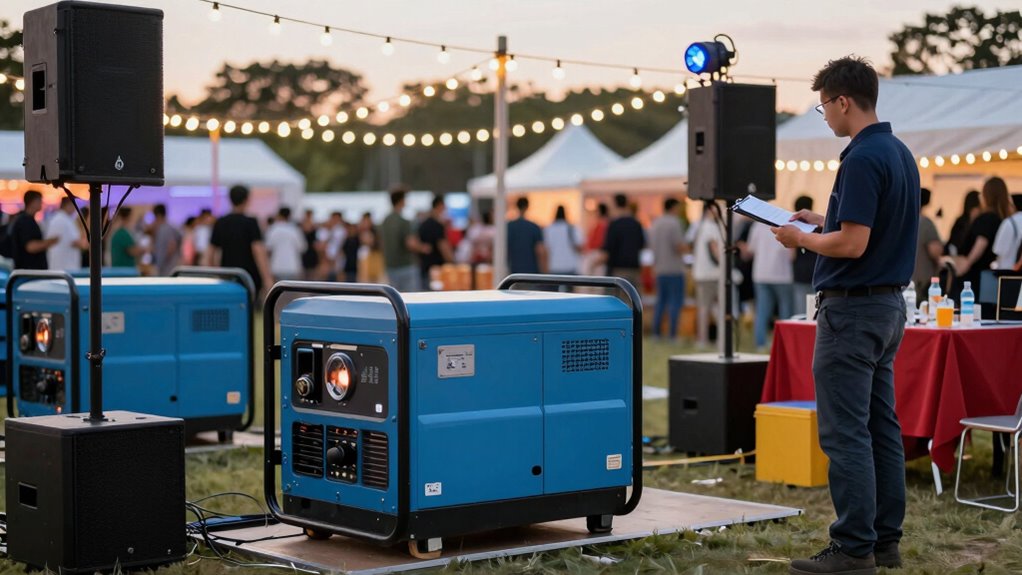
In addition, factor in the nature of your event. If you’re hosting a concert, outdoor wedding, or festival, your power demand might fluctuate throughout the event. In such cases, choosing a generator with a higher capacity than your initial calculation ensures it can handle peak loads comfortably. Proper planning of power demand, coupled with a prudent safety margin, guarantees your event runs smoothly without interruptions, blackouts, or equipment damage. This careful approach minimizes stress and keeps your focus on hosting a successful event rather than troubleshooting power issues.
Frequently Asked Questions
How Do Outdoor Conditions Affect Generator Performance During Events?
Outdoor conditions critically impact your generator’s performance during events. Weather considerations like rain, wind, or humidity can cause fluctuations or interruptions, so you need to prepare accordingly. Temperature effects are essential; high heat can lead to overheating, while cold weather can reduce efficiency or cause starting issues. You should guarantee proper ventilation, shelter, and maintenance to keep your generator running smoothly despite challenging outdoor conditions.
What Safety Precautions Should Be Taken When Operating Large Generators?
You should always prioritize safety when operating large generators. Regular generator maintenance guarantees it runs smoothly and reduces the risk of malfunctions. Keep fire extinguishers nearby, and never bypass safety features. Know how to perform an emergency shutdown quickly if needed. Also, make certain proper ventilation to prevent carbon monoxide buildup. Training your team on these safety precautions minimizes accidents and keeps everyone safe during your event.
Can Generators Be Rented With Built-In Automatic Shutoff Features?
Yes, many generators are available with built-in automatic shutoff features. These enhance generator safety by preventing overloads and overheating, guaranteeing safe operation during your event. When renting, check if the generator includes automatic shutoff, as it helps protect your equipment and avoids potential hazards. Always read the safety instructions and verify the automatic shutoff function is properly maintained to keep your event running smoothly and safely.
How Long Can a Generator Run Continuously During an Event?
You can run a generator continuously during an event, but it depends on fuel efficiency and maintenance. Typically, a generator with a full tank can operate for 8-12 hours, though some models last longer with proper care. Keep noise levels in mind, especially for late-night events, as prolonged runs can increase noise. Regular refueling and monitoring guarantee reliable power without risking overheating or shutdowns.
What Are the Environmental Impacts of Using Gasoline Versus Diesel Generators?
You should consider that gasoline generators typically have better fuel efficiency, meaning they use less fuel for the same output, but diesel generators tend to produce lower emission levels, making them more environmentally friendly. Diesel engines emit fewer greenhouse gases and particulate matter, helping reduce air pollution. Gasoline generators may be more convenient for smaller, short-term use, but diesel options are often better for prolonged, high-capacity needs due to their cleaner emissions.
Conclusion
Now that you know how to calculate your event’s wattage needs, you can choose a generator that’s just right—like a glove fitting perfectly. Proper sizing prevents blackouts and keeps everything running smoothly, so your event flows seamlessly. Remember, a generator that’s too small is like a shoe that’s too tight—you’ll struggle to get everything done. With the right wattage, you’ll keep the energy high and the show going without a hitch.