
TL;DR

Get pool and patio gear delivered free with Prime
- Fast, free delivery on millions of items
- Prime Video, Amazon Music and more included
- Member-only deals all year
A Livingetc report explains kogei as Japanese everyday objects rooted in regional materials, accumulated knowledge and human judgment. Nakagawa executive vice president Tasuku Ogino says the tradition often relies on groups of specialists, while employment in Japan’s traditional craft industries fell from 288,000 in 1979 to 48,334 in 2022.
A Livingetc report on kogei, a Japanese approach to everyday objects, argues that the tradition is defined less by hand-making than by ties to local materials, inherited skills and makers’ judgment. The distinction matters as Japan’s traditional craft industries have contracted: figures cited in the report show employment falling from 288,000 in 1979 to 48,334 in 2022.
The report describes kogei as objects made for daily use, such as cloth, bowls and kettles, whose forms reflect the materials and living conditions of particular regions. Tasuku Ogino, executive vice president of Nakagawa, a Japanese home-goods company founded in Nara in 1716, says the idea brings together practical knowledge built over generations and the skills of makers. Nakagawa now works with more than 800 workshops across Japan, according to the report.
Ogino says an object need not be made entirely by hand to qualify. The report points to Nakagawa’s Hana Fukin kitchen cloth, developed from kaya, a breathable mosquito-net fabric associated with Nara. It is machine-woven, but workers adjust production for humidity and the behavior of individual looms. The account presents those decisions as an example of how human judgment remains part of the process.
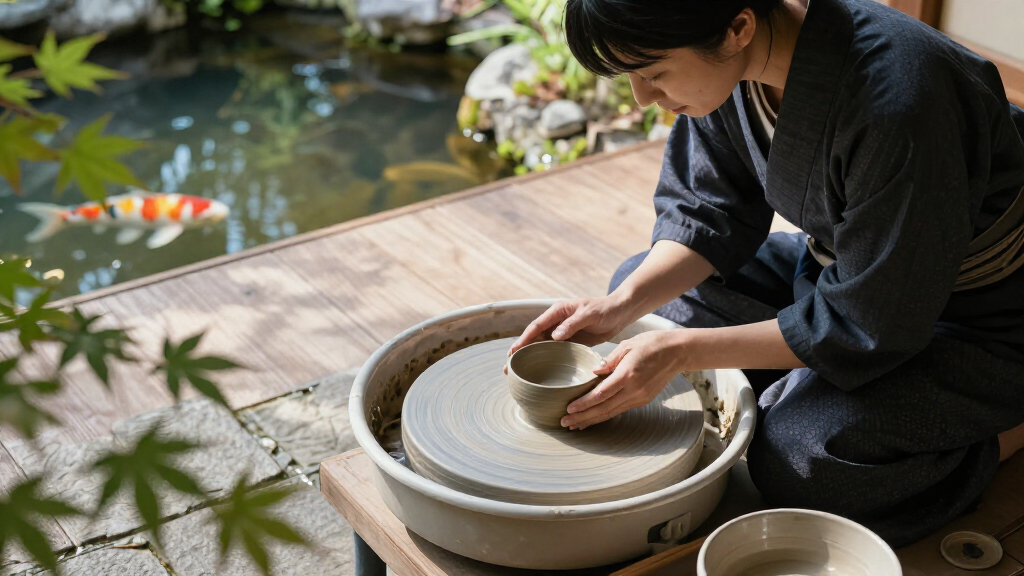
Kogei production can also involve several specialists rather than one celebrated maker. In pottery, the report says, people working with clay, glaze, molds and firing may contribute within the same region. Those roles depend on one another, making the loss of a single specialist a potential problem for the wider production chain. The report also notes that Japan has a formal register of Living National Treasures, while saying that collective work is common in ordinary craft production.
Why Regional Craft Networks Matter
The report’s central point is that kogei is not just a style for arranging or selecting attractive homewares. It links an object’s usefulness to the place, materials and people behind its production. That perspective can change how buyers and designers assess an item: a maker’s name or visible handwork may matter less than whether a regional chain of knowledge and skills still supports it.
The employment figures cited by Livingetc underline the pressure on those networks. Traditional craft industry employment in Japan declined from 288,000 in 1979 to 48,334 in 2022. The figures do not explain the causes of that decline, but they indicate why preserving specialist roles and local production ecosystems is a concern for Nakagawa, as described by Ogino.
For readers interested in interiors, the idea offers a practical way to look at everyday objects: consider how they work, where their materials and techniques come from, and what kinds of expertise are needed to keep making them. The report’s design framing is an interpretation of kogei’s value, not evidence that a particular display approach will produce a specific effect.
As an affiliate, we earn on qualifying purchases.
From Nara Materials to Daily Use
The term kogei is written 工芸. In the report, it is distinguished both from fine art made primarily for appreciation and from industrial production focused on uniformity and efficiency. Its emphasis is on useful objects that can adapt as daily life changes while retaining knowledge developed in a particular place.
The source says Japan’s government criteria for traditional crafts begin with everyday use and lists 244 crafts, with at least one in each of the country’s 47 prefectures. Livingetc also describes a divide between the image of a single master artisan and the collaborative labor involved in many regional industries. These details provide context for Ogino’s argument that supporting kogei means sustaining the communities and expertise behind objects, not just preserving a finished product.
“What matters is whether the object is rooted in its local environment and in accumulated wisdom about daily life.”
— Tasuku Ogino, as quoted by Livingetc
Limits of the Report’s Evidence
The source does not give the date of publication or identify the original source for the employment figures, so readers cannot assess from the report alone how the totals were compiled or what caused the decline. It also does not specify which craft sectors account for the change, or how many regional specialists and workshops remain active today.
The report offers Ogino’s account of kogei and examples from Nakagawa, but it does not establish that every Japanese craft maker or industry uses the term in the same way. Nor does it quantify the effect of the company’s work with more than 800 workshops on employment or the long-term survival of those production networks.
The Future of Workshop Networks
The report does not announce a new program, policy or upcoming milestone. It frames the ongoing challenge as keeping regional skills and production relationships viable as traditional craft employment contracts. Nakagawa’s stated aim, through Ogino, is to pass on the ecosystems that support kogei, rather than only individual objects or techniques.
Further reporting would be needed to establish how those networks are changing, what support workshops receive, and whether demand for everyday craft goods can sustain specialist roles. For readers, the next step is to look beyond appearance and ask how an object is made, where its materials come from and whether the knowledge behind it is still being practiced.
Key Questions
What does kogei mean?
Kogei refers, in the Livingetc report, to useful objects shaped by regional materials, practical knowledge passed across generations and makers’ skills. The term centers on everyday use rather than rarity or display alone.
Does kogei have to be handmade?
No. Ogino says hand-making is not the defining test. The report’s example is a machine-woven kitchen cloth whose production still depends on workers’ adjustments and judgment.
Is kogei usually made by one artisan?
Not necessarily. The report says production may be divided among regional specialists, such as workers responsible for different stages of pottery-making. It distinguishes this collective work from the familiar image of a single master artisan.
Why is kogei under pressure?
The report cites a decline in employment in Japan’s traditional craft industries, from 288,000 in 1979 to 48,334 in 2022. It does not specify the causes or provide a breakdown by craft.
Source: rss
Halloween Picks
halloween
As an affiliate, we earn on qualifying purchases.