TL;DR

Get pool and patio gear delivered free with Prime
- Fast, free delivery on millions of items
- Prime Video, Amazon Music and more included
- Member-only deals all year
Amateur Gardening has shared six ways to support plants using household items and garden leftovers, rather than buying new equipment. The ideas range from an old ladder for a climber to chopsticks for small plants; each needs to be matched to the plant’s size and support needs.
Amateur Gardening has outlined six ways to support plants using items such as an old ladder, a wire wastebasket, reusable straws, chopsticks, pruned branches and garden twine. The suggestions offer gardeners alternatives to buying new supports, with the report stressing that the right choice depends on the plant’s size and the kind of support it needs.
The options cover different jobs in the garden. A sturdy old ladder can give a climbing plant a structure to scramble over, while an upside-down wire wastebasket can surround a bushy perennial and help keep stems from spreading across nearby plants or paths. The report recommends securing a ladder against a stable structure before guiding stems over its rungs.
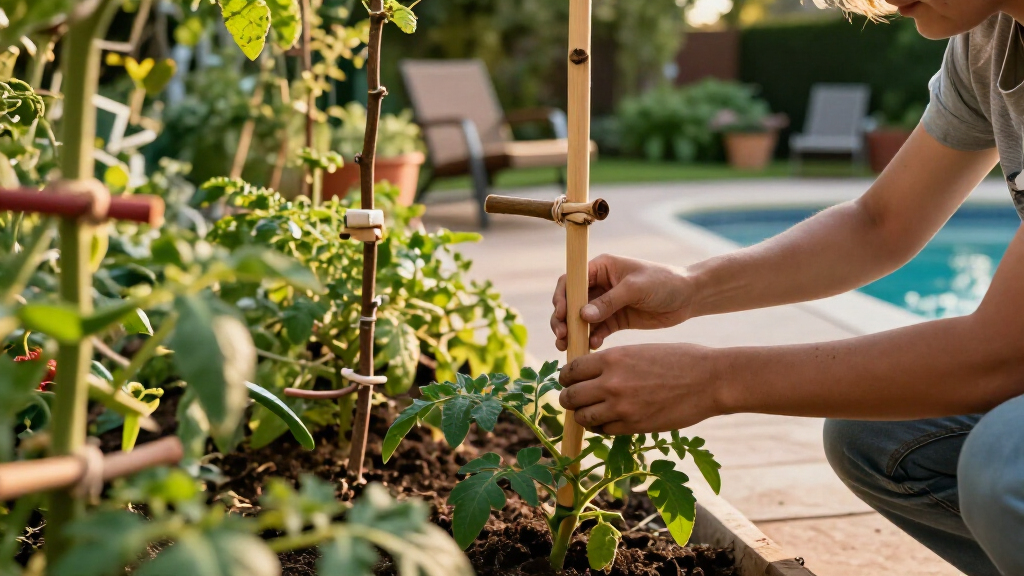
For smaller plants, a metal straw or wooden chopstick can serve as a slim stake beside a leaning stem. Attach the stem loosely with soft string or garden twine, leaving room for it to grow. Chopsticks can also be arranged in pairs or groups and connected with string when a young plant needs support from more than one direction.
Gardeners can use straight, sound branches left after pruning to support floppy plants, setting several around a perennial or using a forked branch to prop up an individual stem. The sixth idea is to tie twine to a sturdy existing feature, such as a fence or railing, creating lines or a grid for a lightweight climber. These methods are suggestions, not a guarantee that every reclaimed item will suit every plant or site.
Match Supports to Plant Needs
The practical point is to choose a support according to the plant’s growth and weight, rather than treating all supports as interchangeable. A thin straw or chopstick may steady a young plant or a single leaning stem, but the report says it is not adequate for a tall perennial or a vigorous climber. A heavier plant may need a broader, firmer structure, such as a well-anchored cage or several sturdy branches.
Using items already on hand may help gardeners avoid some purchases and give otherwise unwanted objects a new use. It can also make use of pruned branches that might otherwise be discarded. The savings will vary: the report does not provide prices, cost comparisons or a measure of how long each support lasts.
Support placement also affects safety and plant health. The report advises securing the ladder and anchoring branches firmly, since foliage can catch wind and heavier growth can strain a structure. Ties should be loose enough not to constrict stems, while damaged or sharp materials may pose risks to gardeners and plants.
As an affiliate, we earn on qualifying purchases.
Why Plants Need Support
Plants that stood upright earlier in the growing season can lean or flop as they grow taller, spread, or develop heavy flower heads. The source report points to late summer and early fall as a time when these problems may become apparent, including stems that fall across paths or neighboring plants.
The six ideas are framed as household and garden re-use, not as a replacement for purpose-built equipment in every situation. Their suitability depends on factors including plant size, the strength and condition of the object, and whether a fixed structure is available. The source does not name particular plant species for each method beyond describing broad categories such as climbers, bushy perennials, seedlings and small container plants.
Limits of the Reuse Ideas
The report does not give measured cost savings, testing results, or durability comparisons for the six supports. It also does not specify how much weight each item can safely bear, how long materials will last outdoors, or which plant varieties suit each option. Gardeners will need to judge the condition and stability of the materials and the needs of the individual plant.
Some recommendations include safety caveats: avoid a badly rusted or unstable wire basket, cover rough edges, and secure a ladder before it supports mature foliage. Branches should be free of rot or signs of disease and firmly anchored. The source offers no separate guidance on material treatment or on the suitability of every kind of twine, straw or ladder for outdoor use.
Check Stability as Plants Grow
Gardeners considering these methods can first identify whether a plant needs a stake, support around its full circumference, or a structure to climb. They can then inspect available items for damage and stability, place the support before growth becomes difficult to manage, and attach stems without tying them tightly.
As plants get larger, supports should be checked for loosened ties, shifting stakes and strain from foliage or wind. The report does not announce a follow-up, product test or additional guidance. Its central recommendation is to use what is available only when it suits the job, and to replace or reinforce a support if it is no longer stable.
Key Questions
What household items can be used as plant supports?
The report suggests an old ladder, wire wastebasket, reusable metal straw, wooden chopsticks, fallen branches and garden twine attached to an existing sturdy structure. Each is intended for different plant sizes and growth habits.
Can a metal straw support a large plant?
The report recommends metal straws for small container plants or a delicate, leaning stem. It says they are not substantial enough for a tall perennial or vigorous climber.
How should a wire wastebasket be used as a plant cage?
Turn an open-wire basket upside down over a plant and push its rim into the soil so stems can grow through the gaps. Do not use a basket that is unstable, badly rusted or has sharp sections.
What should I check before using branches or a ladder?
Choose sound branches without rot or signs of disease and anchor them firmly. A ladder should be stable and secured against a wall, fence or other suitable structure before a climber is guided over it.
Source: rss
Halloween Picks
halloween
As an affiliate, we earn on qualifying purchases.