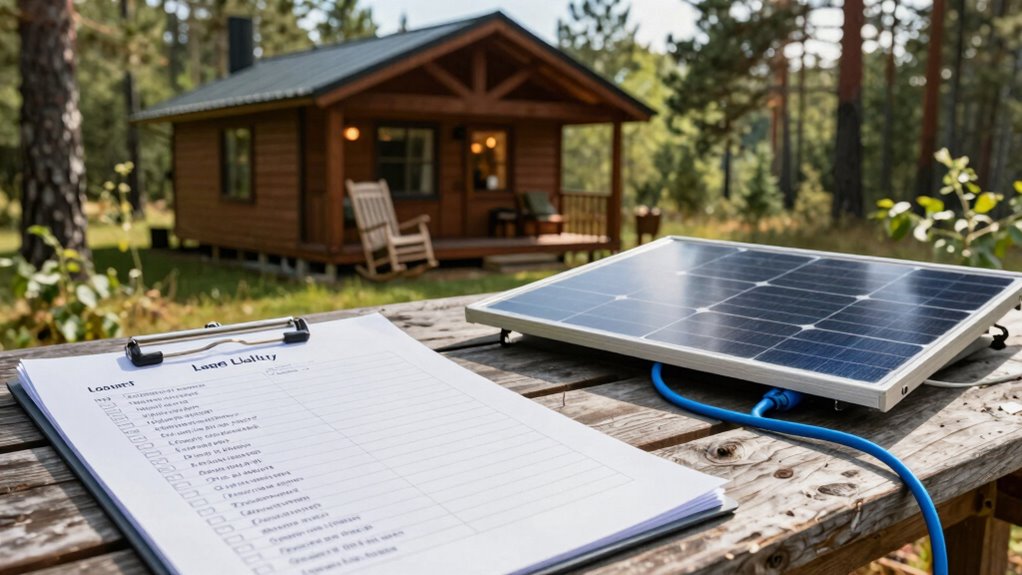
To size your solar generator for a cabin, start by listing all essential appliances and devices you want to operate. Measure their power consumption in watts, then add up these numbers to find your total load. This helps you select the right system size, including battery capacity and inverter rating. A well-prepared load list guarantees you won’t overspend or fall short on power. Keep going to discover how to fine-tune your setup for maximum efficiency.
Key Takeaways
- Create a detailed load list of all essential appliances to determine total power needs.
- Sum individual wattages to establish the system’s baseline capacity.
- Choose a battery capacity that exceeds daily consumption for reliable backup.
- Select an inverter with a continuous watt rating higher than peak load, including headroom.
- Consider inverter efficiency and energy conservation to optimize system size and performance.

Choosing the right solar generator size for your cabin is essential to guarantee you have enough power without overspending on unnecessary capacity. To do this effectively, you need to carefully consider your load list—what appliances and devices you plan to run—and then match that with the appropriate battery capacity and inverter selection. The goal is to balance enough energy storage and power output without tying yourself to an oversized, costly system. Start by listing all the essential items you’ll want to operate, such as lights, a refrigerator, a small heater, or chargers for electronics. Once you have that list, determine their individual power consumption, usually measured in watts. Add these figures up to find your total load; this will serve as the foundation for choosing your solar generator.
Battery capacity plays a vital role in ensuring your cabin remains powered during cloudy days or at night when the sun isn’t shining. You’ll want a battery capacity that comfortably exceeds your daily energy needs, giving you some buffer for unexpected usage or days with less sunlight. For example, if your total daily energy consumption is around 2 kWh, choosing a battery with at least 4 kWh of capacity provides a good margin, ensuring you won’t run out of power prematurely. Remember, larger battery capacities tend to be more expensive but offer greater flexibility and reliability. You should also consider how fast you need your batteries to charge and discharge, which depends on your inverter selection.
Additionally, understanding the importance of energy efficiency in your system can help you optimize performance and reduce costs over time. Speaking of inverters, selecting the right one is pivotal because it converts the stored DC power from the batteries into AC power for your appliances. You must choose an inverter with a continuous wattage rating that exceeds your peak load—meaning the highest sum of all appliances running simultaneously. If your load list totals 1,500 watts at peak, opt for an inverter rated at least 2,000 watts to provide some headroom and prevent overloads. Additionally, consider whether you need a pure sine wave inverter, which offers cleaner power suitable for sensitive electronics, or if a modified sine wave inverter would suffice for simpler devices. The inverter’s efficiency also affects how much energy you can get out of your batteries, influencing your overall system size and longevity.

Jackery Solar Generator 1000 v2 with 200W Solar Panel,1070Wh Portable Power Station LiFePO4 Battery,1500W AC/100W USB-C Output, 1Hr Fast Charge for Outdoor,Off-Grid Living,RV,Emergency
- Powerful AC Output: 1500W continuous, 3000W surge
- Lightweight and Portable: Only 23.8 lbs with foldable handle
- Fast Charging: Full charge in 1 hour via app
As an affiliate, we earn on qualifying purchases.
As an affiliate, we earn on qualifying purchases.
Frequently Asked Questions
How Often Should I Perform Maintenance on My Solar Generator?
You should perform maintenance on your solar generator every 3 to 6 months. During this time, check your battery maintenance and clean your system components to guarantee peak performance. Regular cleaning schedules help prevent dust and debris buildup, which can affect efficiency. Also, inspect connections and terminals for corrosion or damage. Staying on top of these tasks keeps your solar generator running smoothly and prolongs its lifespan.
Can I Upgrade My Solar System Later?
Yes, you can upgrade your solar system later. For example, if you find your current solar panel efficiency isn’t meeting your energy needs, you can add more panels or upgrade to higher-efficiency models. When planning upgrades, focus on expanding battery capacity and guaranteeing your existing system can handle increased power. This way, you optimize performance and ensure your system evolves with your energy demands.
What Is the Lifespan of a Typical Solar Generator?
A typical solar generator lasts about 8 to 15 years, depending on battery longevity and component durability. You can prolong its lifespan by proper maintenance, such as keeping batteries charged and avoiding overuse. Quality units with high-quality parts tend to last longer. Keep an eye on aging batteries and replace them when needed to ensure your solar generator continues to perform reliably over the years.
How Does Weather Affect Solar Generator Performance?
Weather impacts your solar generator’s performance mainly through solar irradiance and seasonal variation. Cloudy days reduce sunlight, lowering energy output, while snow or rain can block sunlight altogether. During winter, shorter days and lower solar irradiance decrease efficiency, so you might need a larger system or backup power. Planning for seasonal variation guarantees your cabin remains powered, regardless of weather conditions.
Are There Backup Options for Cloudy Days?
Sure, when clouds roll in and your solar generator’s performance dips, don’t panic—just rely on your backup options. Boost your battery capacity beforehand, so you’re prepared for those gloomy days. A larger battery acts as a cloud-day backup, storing extra power for when sunlight’s scarce. It’s like having a financial safety net—only for electrons—ensuring your cabin stays cozy, rain or shine.
Conclusion
Sizing your solar generator for a cabin is like planting a garden—you need the right amount of seeds to guarantee a bountiful harvest. When I first calculated my load, I realized I was underestimating my needs, and my system struggled during cloudy days. Now, with proper sizing, my cabin runs smoothly, rain or shine. Just like tending a garden, thoughtful planning ensures your solar setup grows strong and reliable, keeping your cabin powered no matter the weather.