To estimate how long your portable power station will last, check its capacity in watt-hours (Wh) and sum the wattage of your devices. Divide the capacity by the total wattage to get a theoretical runtime, then adjust for efficiency—usually about 90%. Keep in mind factors like battery age and temperature can affect this. If you want more precise methods, you’ll find helpful tips ahead that make planning easier.
Key Takeaways
- Calculate theoretical runtime by dividing the battery capacity (Wh) by total device wattage (W).
- Adjust estimated runtime for charging efficiency, usually around 90%, to reflect real-world performance.
- Consider additional factors like temperature, device startup surges, and battery age that can affect actual runtime.
- Use device wattage labels or manuals to accurately determine power consumption for better estimates.
- Incorporate a safety buffer into calculations to prevent unexpected power shortfalls during operation.
Portable power stations are versatile devices that provide reliable electricity wherever you need it, making them perfect for camping trips, outdoor events, or emergency situations. When you’re choosing a power station, understanding how long it can run your devices without guessing is essential. This relies heavily on two key factors: battery capacity and charging efficiency. Battery capacity, usually measured in watt-hours (Wh), tells you how much energy the station can store. The higher the capacity, the longer you’ll be able to power your devices. Charging efficiency, on the other hand, indicates how effectively the station converts the energy from the power source into usable power without loss. A higher charging efficiency means less energy wasted, enabling more effective use of the stored energy.
To estimate runtime accurately, start by looking at the battery capacity. For example, if your power station has a capacity of 500 Wh, it can theoretically provide 500 watts for one hour or 250 watts for two hours, and so on. But real-world usage isn’t always this straightforward. You also need to consider the power demand of your devices. Check the wattage of each device you plan to connect; this information is usually on the device’s label or in its manual. Divide the total wattage of all devices by the power station’s capacity to get a rough idea of how many hours they can run. For instance, if your devices total 100 watts, a 500 Wh station could run them for about five hours, assuming 100% charging efficiency.
However, charging efficiency plays a significant role. No power station is perfectly efficient, and some energy is lost during conversion. If the efficiency is 90%, you’ll only get 90% of the theoretical runtime. To account for this, multiply your estimated runtime by the efficiency percentage. Continuing with the previous example, five hours multiplied by 0.9 gives approximately 4.5 hours of actual runtime. Additionally, navigation and mapping features in some advanced power stations can help optimize energy use by monitoring device consumption in real-time.
Keep in mind that factors like temperature, device startup surges, and the age of the battery can affect these estimates. It’s a good idea to add a buffer to your calculations to ensure your devices won’t run out unexpectedly. By understanding your power station’s battery capacity and charging efficiency, you can make smarter decisions about how many devices to run and for how long, ensuring you’re never left in the dark when you need power most.

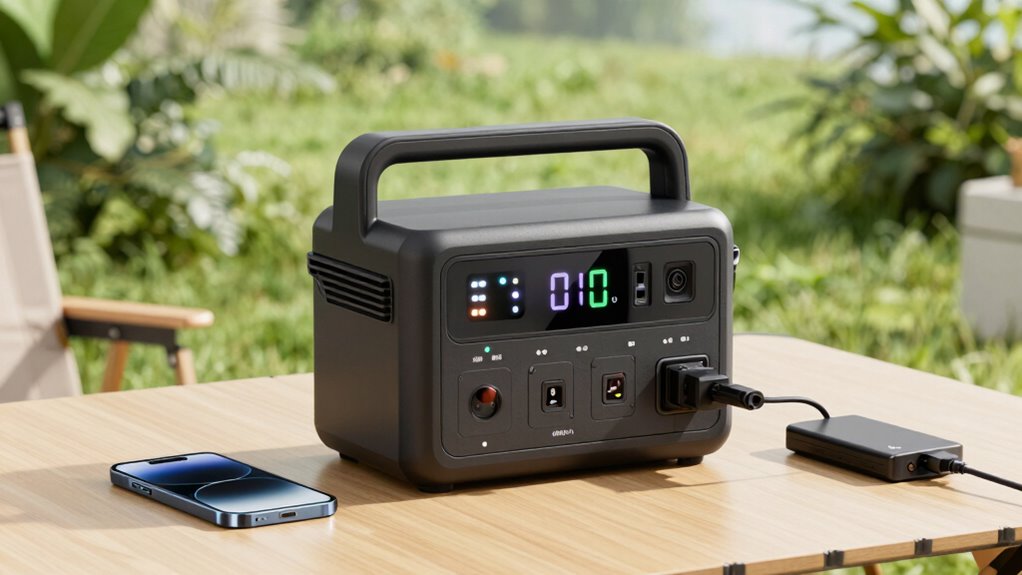
LIBRIDS Portable Power Station C600, 640Wh LiFePO4 Battery, 600W (Peak 1200W) Solar Generator, 1.5H Fast Charge, 10ms UPS, 8 Ports(4 AC) for Camping, Home Backup & Outages
- Reliable UPS Backup: Automatically switches during outages
- Large Capacity and Power: 640Wh capacity, 600W continuous output
- Fast Charging: Full charge in 1.5 hours
As an affiliate, we earn on qualifying purchases.
As an affiliate, we earn on qualifying purchases.
Frequently Asked Questions
How Do Temperature Changes Affect Power Station Runtime?
Temperature fluctuations can substantially impact your power station’s runtime by affecting battery efficiency. When it’s too cold, your battery’s chemical reactions slow down, reducing capacity and overall efficiency. Conversely, high temperatures can cause batteries to overheat, leading to faster degradation and less reliable performance. To maximize runtime, keep your power station in a moderate environment, avoiding extreme temperature changes that harm battery efficiency and shorten usage time.
Can Solar Charging Extend Runtime Significantly?
Did you know that adding a solar panel can boost your power station’s runtime by up to 50%? Solar charging definitely extends your station’s operational time, especially when your battery efficiency is high. By using a solar panel, you harness free sunlight, reducing reliance on grid power and maximizing your station’s capacity. So, if you want longer use without guessing, solar charging is a smart, eco-friendly choice.
What Is the Lifespan of a Portable Power Station?
You can expect a portable power station’s lifespan to be around 3 to 5 years, but it varies depending on battery degradation over time. To guarantee longevity, check the warranty coverage, which often highlights the expected cycle life. Proper maintenance and avoiding deep discharges help reduce battery degradation, extending the station’s usefulness and keeping it reliable for your power needs over the years.
How Do Different Device Types Impact Runtime Estimates?
You’ll find that different device types drastically impact runtime estimates; high-wattage tools drain power faster than low-wattage gadgets. While larger battery capacity provides more energy, device efficiency also matters—more efficient devices use less power, extending runtime. Think of it as comparing a sprint to a marathon: your power station’s capacity is your stamina, but how efficiently your device uses that energy determines how long you can keep going.
Are There Safety Considerations When Estimating Runtime?
Yes, safety considerations matter when estimating runtime. You should follow safety protocols, like avoiding overloading the power station and ensuring proper ventilation. Always read user precautions to prevent accidents, such as overheating or short circuits. Keep an eye on device temperature and never push the station beyond its capacity. By prioritizing safety, you protect both yourself and your equipment while accurately estimating usage time.
Conclusion
Just like explorers charting unknown waters, estimating your portable power station’s runtime helps you navigate power needs confidently. By understanding your device’s capacity and your consumption, you avoid surprises—much like Odysseus steering past storms. With a little planning, you’ll keep your adventures running smoothly, ensuring your devices stay alive when you need them most. So, equip yourself with knowledge, and let your power station be your loyal compass in every journey ahead.